THE PERSONA PROBLEMEach generation forgets
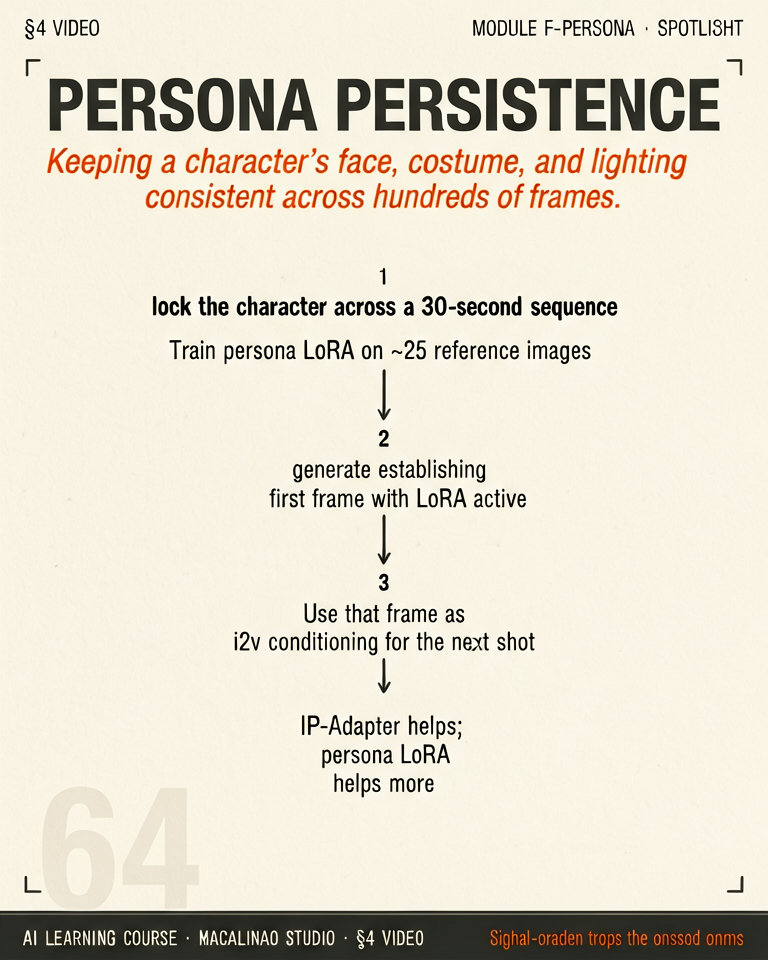
An AI music idol or a brand mascot needs to look the same in every video. The model has no memory of "this is my character" between generations. Naive text prompts ("a woman with red hair, green eyes, freckles") drift — her face changes from clip to clip, her freckles disappear, her hair turns auburn. Persona persistence is the engineering problem of locking identity across hundreds of frames and dozens of generations.
VISUAL DNAA persona is structured data, not a prompt
Treat the persona as a versioned record: face descriptors (eye color, jaw shape, freckle pattern), wardrobe rules, lighting preferences, posture defaults. Store as JSON. Every generation pulls from the same record. This is what separates a real character from a generated face — without it, every shoot starts at zero.
REFERENCE INJECTIONIP-Adapter + LoRA + DreamBooth, all at once
For maximum persistence: train a DreamBooth on 100+ shots of the persona (one-time), train a LoRA on the persona's specific lighting/aesthetic (recurring), and use IP-Adapter at inference with 3-5 reference frames pulled from the persona's library. The three techniques compound: DreamBooth locks the face shape, LoRA captures the look, IP-Adapter handles per-shot variations.
CROSS-CLIP CONSISTENCYSame persona, different shots, same identity
For multi-shot videos: feed the same persona reference inputs into every shot — seeds do not transfer identity across shots in DiT models, so "same seed offset" folklore buys you nothing. When a shot drifts, run a face-swap/restore post-pass (ReActor / FaceFusion-class tools) or regenerate the shot. Practical heuristic: if you can't tell the persona is the same across two random frames, audiences won't either — reshoot.
2026Character reference is now a built-in feature
Commercial models ship identity persistence natively: Runway Gen-4 references, Kling elements, Veo ingredients, Midjourney omni-reference. Zero-shot ID models (InstantID, PuLID, Kontext-class editing) cover most remaining cases with no training at all. The training-heavy LoRA path is still the workhorse for open-weight pipelines that need exact, locked control over a production identity. One compliance note: EU AI Act deepfake transparency obligations apply from August 2026 — synthetic-person content needs disclosure baked into the pipeline.