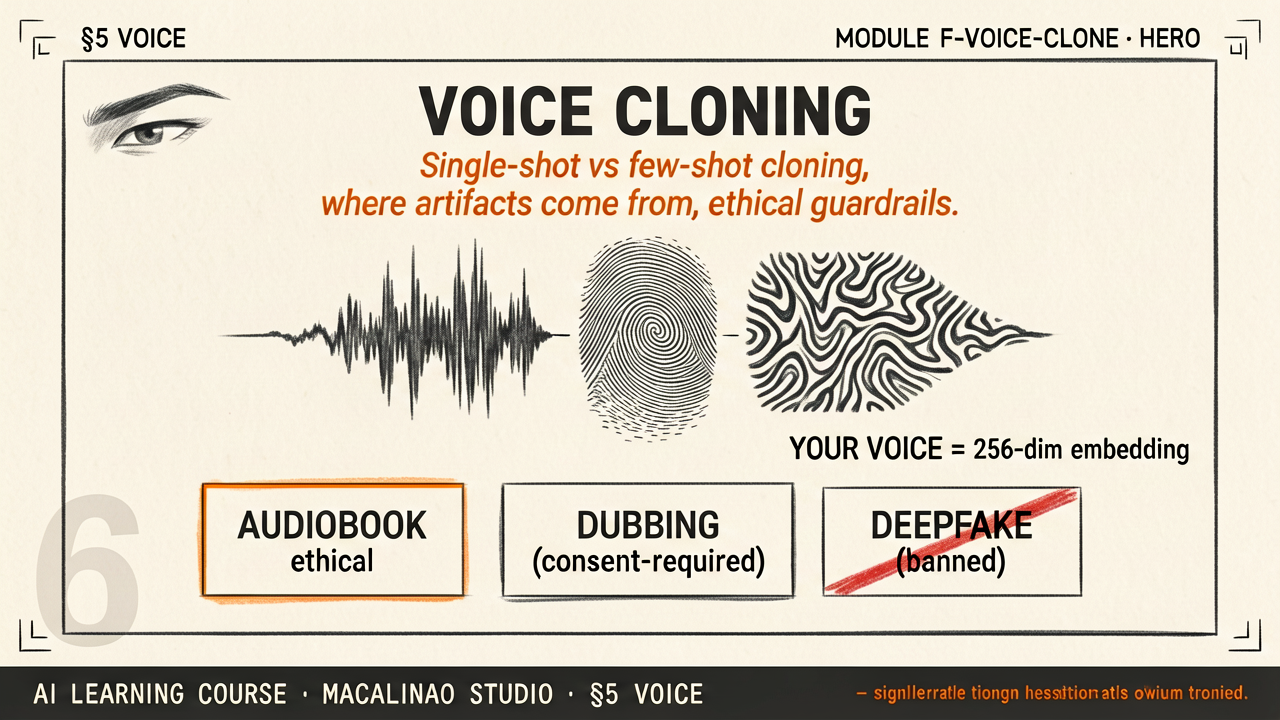
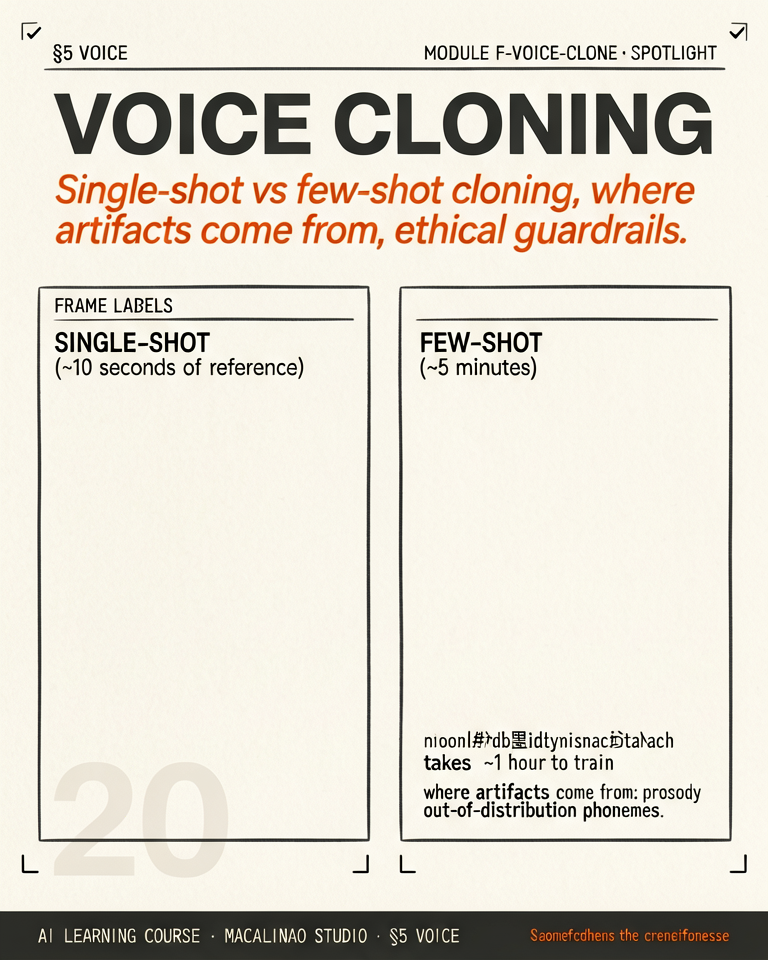
Single-shot vs few-shot · artifacts · ethical guardrails
SINGLE-SHOT VS FEW-SHOT
How much reference audio you actually need
Single-shot (3-15 seconds of reference): works for casual sound-alike. Captures broad voice color but loses prosodic patterns. Good for first-pass concept work. Few-shot (30 seconds to 5 minutes): captures prosody, breathing rhythm, characteristic emphasis. Studio-grade (30+ minutes across multiple emotions): gives you a voice that's actually convincing across long-form narration. ElevenLabs' Professional Voice Cloning is in this tier.
WHERE ARTIFACTS COME FROM
The audible signatures of cloned voices
Cloned voices fail in specific ways: (1) consonant smearing at fast speech rates, (2) misplaced breath/pause patterns (modern codec LMs generate breaths — just in the wrong places), (3) drift in pitch register on emphasized words, (4) emotion bleeding (model adds drama that wasn't in the reference). Each artifact has a fix — usually more / cleaner reference audio.
ETHICAL GUARDRAILS
The non-negotiable patterns
Consent first: the person whose voice you're cloning must explicitly agree, in writing, for each project. Watermarking: every generated audio file should carry an inaudible watermark that can be detected after release. Refusal lists: no cloning of public figures (politicians, journalists, celebrities) without legal review. Audit logs: every clone request logged with the requester and purpose. These aren't optional in 2026.
LAW · 2026
The guardrails are now law
EU AI Act deepfake transparency obligations apply from August 2026 — synthetic voice content must be disclosed. Tennessee's ELVIS Act (2024) made voice likeness a protected right. The FCC ruled AI-cloned robocall voices illegal (2024). Provenance tech to know: AudioSeal (inaudible watermarking) and C2PA (content credentials). The abuse economics are stark: 3 seconds of audio is enough to clone a voice, while banks still run voice-authentication systems designed before that was possible.
PRACTICAL WORKFLOW
From reference recording to deployable voice
(1) Record 5-10 minutes of clean reference in a quiet room. (2) Process to remove background noise, normalize loudness. (3) Train or upload to your TTS provider. (4) Validate on 20+ test sentences across emotional ranges. (5) Generate watermarked production audio. (6) Keep the source recording in cold storage so the voice can be re-trained if the underlying TTS model is upgraded.